Ris used everywhere espically in Data Science. As Part of our Time Series Analysis and Forecasting Course, our mentor Dr.Prashobhan Palakkeel has given an assignment to do an Exponential Smoothing and ARIMA to analysis a TimeSeries data. I will be explaining the results that I have got.
About the Dataset
I have used the Dataset “HBS Table No.163 Components of Money Stock”. The Series that I have used from the dataset is, “Currency in Circulation”. I have used Exponential smoothing technique and ARIMA methods for modelling and forecasting. I have included the R code that I have used for forecasting and the outputs of each model and comparison between both models.
Analysis of Dataset
The First process after downloading the data set is to read the dataset in R. The Series “Currency in Circulation” has been copied to clipboard. The below R code reads the data from the clipboard and stores it in the variable currency_in_circulation_data.
currency_in_circulation_data <- read.delim('clipboard', header = FALSE)
currency_in_circulation_data
After Reading, I have converted the data to vector.
vec <- as.vector(t(currency_in_circulation_data))
vec
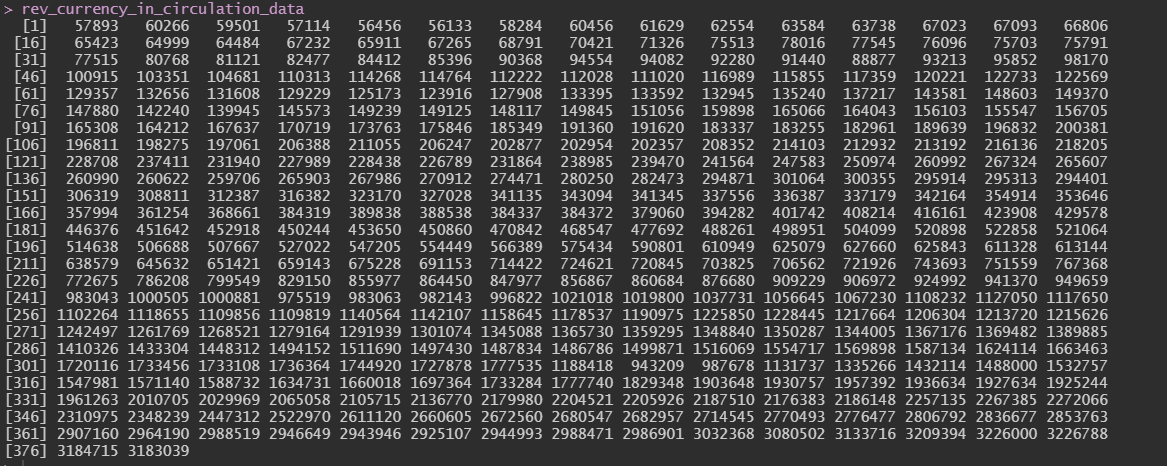
The Vector data has been reversed because, the data in the dataset starts from 2022-23 and ends in 1991-92. The Data should start from 1991-92 and end in 2022-23. To achieve this, the data is been reversed using the rev() function in R.
rev_currency_in_circulation_data <- rev(vec)
rev_currency_in_circulation_data
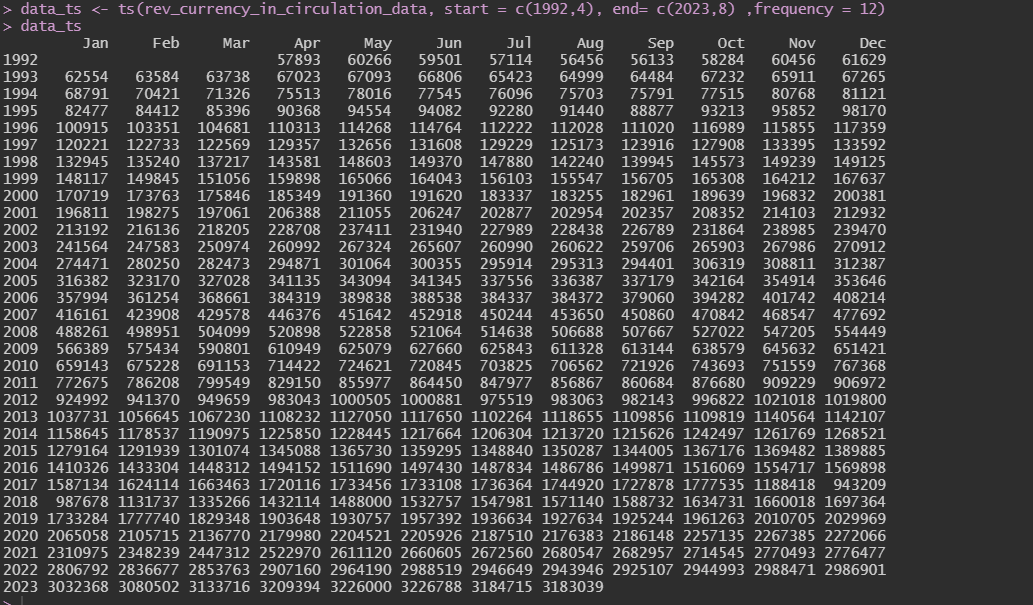
We are converting the reversed vector data which is stored in the variable rev_currency_in_circulation_data into a timeseries data. The Start year will be 1992 - April Month and ends in 2023 - August Month. The Frequency is 12 because, number of months is 12.
data_ts <- ts(rev_currency_in_circulation_data, start = c(1992,4), end= c(2023,8) ,frequency = 12)
data_ts
Plotting the TimeSeries data
plot(data_ts)
boxplot(data_ts)
boxplot.stats(data_ts)
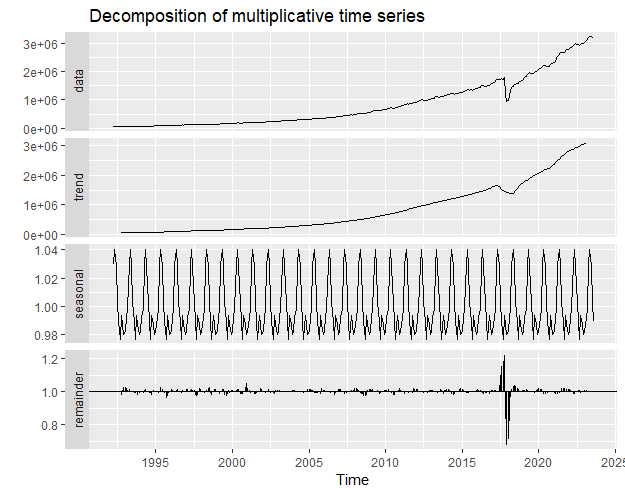
Decomposition of time series data
decom <- decompose(data_ts, "multiplicative")
  autoplot(decom)
Check if the Data is Stationary using KPSS Test. Stationary if the value is test static value is < critical value
#KPSS TEST
  library(urca) #Assumption that, H0 is <- Data is stationary.
  summary(ur.kpss(data_ts))

  ndiffs(data_ts) #Number of time we have to diff to make the data stationary.
  data_diff <- diff(data_ts, 2) #making the data stationary.
  #testing if it become stationary
  summary(ur.kpss(data_diff))
Output Screenshots
Reversed Vector
Time Series Data
TimeSeries plot

Decomposition of time series data
KPSS Unit Test

TimeSeries boxplot

Modelling and forecasting the given time series using the Exponential Smoothing Method
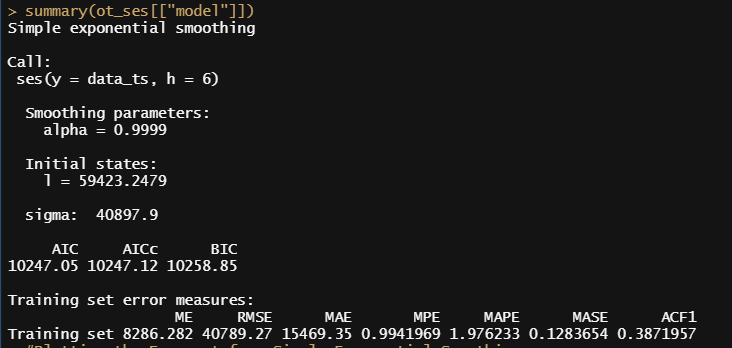
Simple Exponential Smoothing
ot_ses <-ses(data_ts, h=6)
ot_ses #Printing the forecast
summary(ot_ses[["model"]])
autoplot(ot_ses)
Holt's Method
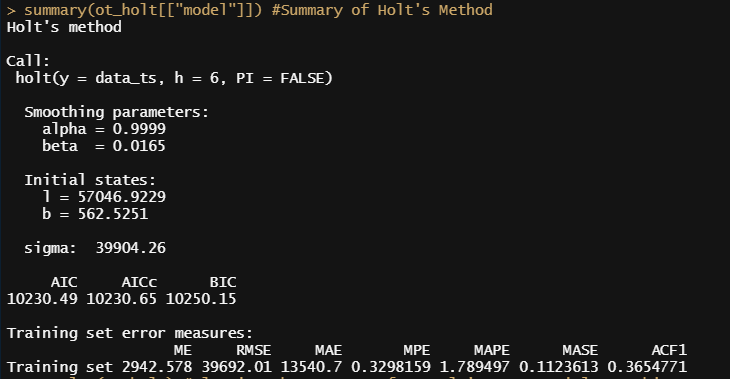
ot_holt <- holt(data_ts, h=6, PI=FALSE)
ot_holt #Printing the forecast
summary(ot_holt[["model"]]) #Summary of Holt's Method
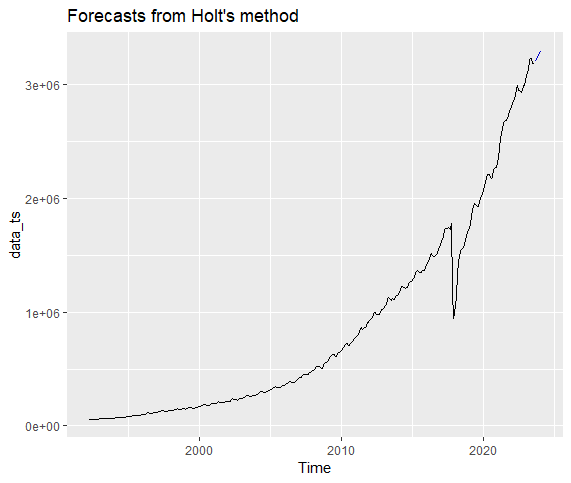
autoplot(ot_holt) #Plotting the Forecast from Holt's Exponential Smoothing.
Holt's Winter Seasonal Method
fit1 <- hw(data_ts, seasonal = "additive")
fit2 <- hw(data_ts, seasonal = "multiplicative")
autoplot(fit1)
autoplot(fit2)

#Forecasting for next 100 months using Holt's Winter Method
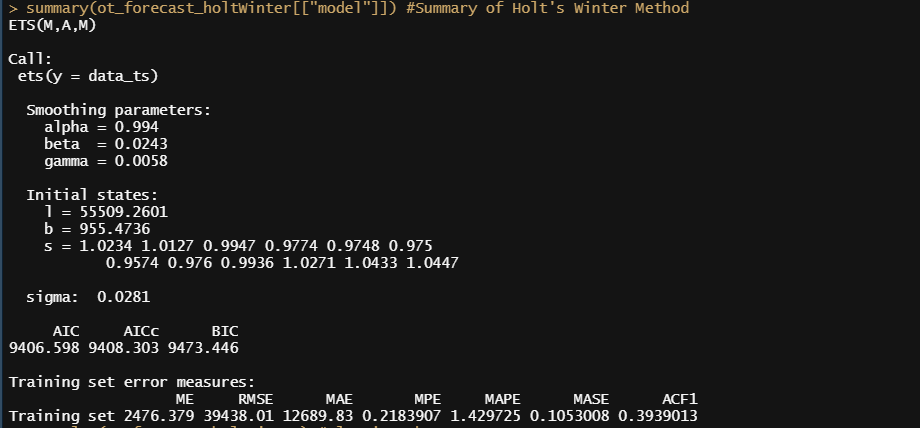
ot_forecast_holtWinter <- forecast(ets(data_ts, model="AAA"), h=6)
ot_forecast_holtWinter #Printing the forecast
summary(ot_forecast_holtWinter[["model"]]) #Summary of Holt's Winter Method
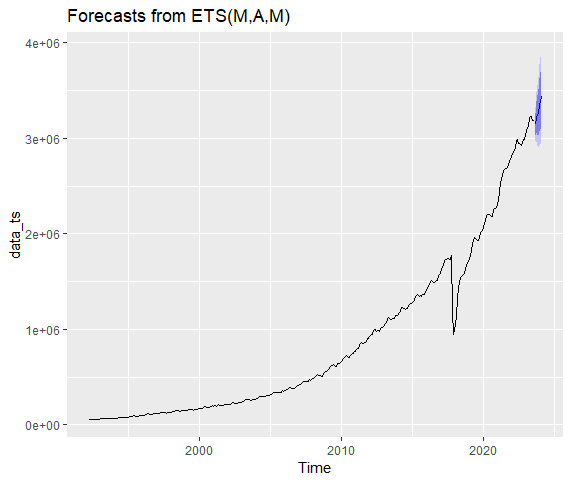
autoplot(ot_forecast_holtWinter) #Plotting the Forecast
Output Screenshots of Exponential Smoothing Method
Summary of Simple Exponential Smoothing
Plot of Forecasts from Simple Exponential Smoothing

Summary of Holt's Method
Plot of Forecasts from Holt's Method
Summary of Holt's Winter Method
Plot of Forecasts from Holt's Winter Method
Modelling and forecasting the given time series using the ARIMA method
ARIMA model for exponential series
ot_arima <- auto.arima(data_ts, trace = TRUE)
ot_arima

#Forecasting using arima - Next 100 Values
ot_forecast_arima <- forecast(ot_arima, 100)
ot_forecast_arima  #Printing the Forecast
autoplot(ot_forecast_arima) #Plotting the Forecast
Augmented Dickey-Fuller Test
data_ts %>% autoplot()
data_ts %>% log() %>% autoplot()
data_ts %>% log() %>% diff %>% autoplot()
data_ts %>% log() %>% diff(lag=12) %>% autoplot()
data_ts %>% log() %>% diff -> prabhu_dif

#Augmented Dickey-Fuller Test
adfTest(prabhu_dif)

plot(stl(data_ts, s.window = 13))
AUTO-ARIMA model
fit <- auto.arima(data_diff)
fit

acf(data_diff, lag.max = 100)
pacf(data_diff, lag.max=20)
ts.plot(data_diff)

#Plotting the forecasts from arima
ot_arima_forecast <- forecast(fit, h=6)
ot_arima_forecast
autoplot(ot_arima_forecast)
Root Mean Square Error
getrmse <- function(x,h,...)
{
    train.end <- time(x)[length(x)-h]
    test.start <- time(x)[length(x)-h+1]
    train <- window(x,end=train.end)
    test <- window(x,start=test.start)
    fit <- Arima(train,...)
    fc <- forecast(fit,h=h)
    return(accuracy(fc,test)[2,"RMSE"])
}

getrmse(data_ts,h=24,order=c(3,0,0),seasonal=c(2,1,0),lambda=0)
getrmse(data_ts,h=24,order=c(3,0,1),seasonal=c(2,1,0),lambda=0)
getrmse(data_ts,h=24,order=c(3,0,2),seasonal=c(2,1,0),lambda=0)
getrmse(data_ts,h=24,order=c(3,0,1),seasonal=c(1,1,0),lambda=0)
Output Screenshots of ARIMA Model
ARIMA model for exponential series
Plots of Forecasts from ARIMA

Augmented Dickey-Fuller Test
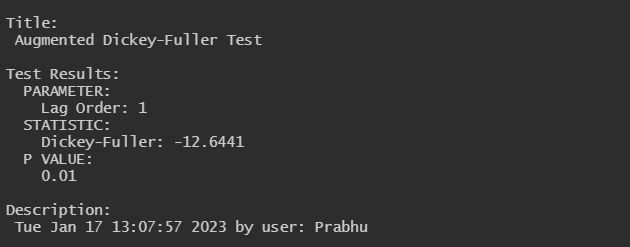
Augmented Dickey-Fuller Test
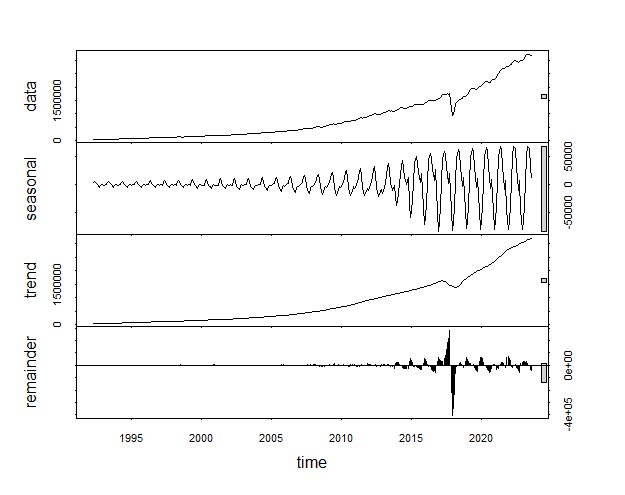
Forecast ARIMA(2,1,0)

RMSE

Comparision of Accuracy of All Models
Accuracy of Simple Exponential Smoothing

Accuracy of Holt’s Method

Accuracy of Holt’s Winter Method

Accuracy of ARIMA for Exponential Series

Accuracy of AUTO-ARIMA Model
